Showing posts with label portrait. Show all posts

Monday, October 13, 2014

Wow! The Lady In Red! You're Perfect! Or...Are You?


 "Oh, Cordelia Brown, what make your head so red?" ~ Harry Belafonte


Like many photographers, my heart sometimes skips a beat when I see an attractive ginger. Man or woman, a handsome, pretty or even interesting-looking person sporting a shock of red hair is fairly unique, at least when it comes to our portfolios.

It's tempting to approach someone right off the bat when we see the hair. If you have any skill at all as a shooter, you figure it's a can't miss. A styling element that will automatically make your image jump off the page.

And maybe you'll be right.

Still, even those of us who are experienced at critically looking at people of every conceivable color, shape, and size (to the point of being our own casting agents) can be fooled by a single strong visual or wardrobe element, and it's often hard to separate the feature that may wow you in person from the way someone will actually appear modeling in a photo.

I know because it's happened. And when it does, and that special someone you swore was perfect when you met them just doesn't look right on your monitor screen, you can only shake your head and wonder what went wrong...

It's a question of learning to really look at a person critically and differentiating between street attractiveness, which many people have (regardless of how photogenic they are), and strong visual features that will come across in a wonderful way when you throw some light on them and the shutter clicks.


Ad photo for kromamakeup.com. Model: Katie. Makeup by Lee Tillett.
Red hair and beautiful face provided by nature.
So, what is one to do? Obviously, there is never a guarantee that someone you meet in person is going to look amazing or be great as a model at a photo shoot. But, you can put the odds more in your favor before you approach people, and that's what my advice here is all about.

Knowing that a person's hair frames their face, it also becomes clear that beautiful hair or a great cut, or in this case hair color can mask subtle or sometimes even major flaws in that face. So, just as casting agents and photographers often want to see potential models with little or no makeup and their hair pulled back away from their face (something that's not at all very practical when you meet someone on the street), I always try to imagine what someone I'm considering casting would look like with a different color hair.

Now, maybe this sounds obvious. Maybe it sounds odd. No matter. It works for me, and by works, I mean it helps me sift through folks that might have really nice or cool or red hair, but otherwise are nothing special when it comes to sticking them in front of the camera. And in my case, one nice feature is usually not enough for me to get involved with them as potential models.

Obviously, you're free to try to style and pose and shoot whomever you want for whatever reason you want. My point is, women with red hair or more importantly, those who change their hair color or appearance to get noticed sometimes get your attention using a bit of smoke and mirrors and for the wrong reasons.

In my experience, it always pays to take a moment and try to imagine someone without the feature that attracted you to them in the first place, and figure out if all the other stuff is strong as well.

You'd be surprised how often it's not...

Tuesday, August 13, 2013

Then One Day The Smithsonian Called: Why You Should Always Save And Archive Your Work!

Well, it took a while, but one of my photos is finally in the Smithsonian.

It's true. I tell you no lie...

Now, it is not in the permanent collection and on display in a museum in Washington, DC for all the world to see. I wish. Rather, it's a portrait I shot of painter Carlos Alfonzo in December, 1990, originally appearing in the publication Miami New Times Newspaper. And it will be used as part of a printed catalog to coincide with the exhibit:

 Our America: The Latino Presence in American Art.


My photo of artist Carlos Alfonso (Cuban, 1950-1991) in his Miami studio, 1990.
Now, I am not the most organized guy in the world, and when it comes to my photography, I have a whole mish-mash of storage systems. Most of my digital work is, of course, logically filed on hard drives and on discs. Oh, and for the most part, key worded. Finding things in the computer age is not usually a problem.

It's my film originals that I probably need to work on a bit. Fortunately, many of my older negatives are neatly stored in chronological order in binders with their labeled proof sheets, and yes, the bulk of my color film slides are in boxes or pages, generally safe, in one searchable place.

Good thing, too.

Because one fine day, I was minding my own business, when out-of-the-blue came an email from an Emma Stratton, Permissions Coordinator, Smithsonian American Art Museum. Now when Ms. Stratton comes a calling on behalf of the Smithsonian, you pay attention.

And so, I paid attention...

And what she asked me oh-so-politely was if she could use my image of Alfonso for the upcoming Smithsonian exhibition catalog. Luckily, she had seen it used before in another catalog for another exhibition at the Miami Art Museum in 1997.

Obviously, I said yes. That was the easy part...

So, after agreeing to the deal, and excitedly shouting to anyone within earshot, I actually had to get down to business. I needed to track down the original negative, make a quality scan, create a digital file in photoshop, edit and retouch that file, then output it in a size and format that met their specifications for the printed catalog. Oh, and get it to them.

All on deadline...

In the end, it was not all that difficult, but without finding that original negative fairly quickly, I most likely would have been screwed.

Which brings me to my point: you need to develop a system of organizing and cataloging your images as you go along. Something that makes sense when you're trying to find an individual photo many many years after it's been shot.

Now, I had no way of knowing that Carlos Alfonso would sadly die not long after he sat for my camera. Nor could I ever imagine what his place and fame would be in the context of Hispanic and American art, or what the demand would be for a picture of him many years later.

But, because I was disciplined enough over the years to keep most of the rolls of film I shot together in pages with their proof sheets in books chronologically in a protected cabinet, I immediately and confidently told Emma Stratton I could send her artwork. I knew it would not take me long to find the negatives from our 1990 portrait session, even in the year 2013, and it didn't.

In this digital age, it is very tempting to simply live for the moment, shoot what we want when we want, and assume the computer will keep it all organized. In a perfect world, maybe, but if you value your work, you really owe it to yourself to pay much more attention to organizing and archiving your images in a way that makes sense.

After all, you never know when someone from the Smithsonian will come knocking on your door...

Saturday, July 30, 2011

Photo Asylum 101: Get That Model Release: In The Photo!

Hopefully, if you're a commercial shooter, or publish your work in any way, shape, or form, you know full well the importance and advantages of having a signed model release from your subject. I'm not going to get into all that today. There are plenty of online resources to help you with releases, including this basic primer from ASMP.

What I would like to do instead, is suggest a good habit to get into when you shoot: snapping a frame or two of your model actually holding the signed release.

Now, every photographer will eventually figure out the way they like to work, but I almost always prefer to have my models sign their releases before we begin shooting. I'm easy-going, my sets are generally relaxed and fun, and most importantly, I have a laptop set up at some point to proof images. My point is there is a fairly high level of trust throughout the whole process, and the majority of models agree to sign without actually knowing precisely how they will be photographed.

One day it occurred to me that photographing the model actually holding the signed release would make a nice, convenient insurance policy, if you will. I have no idea of the legality of the photo should the original document become lost, but having the image right in the same folder as the rest of the shoot does a lot to alleviate any confusion or misunderstandings down the road. It also makes a very good reference file to send along to clients or publications that require documented releases of your models.

flickr-blog-pate-release
Model Robert Pate wouldn't dare deny signing his release as long as I have this!

As you can see, it takes very little effort to find a small piece of foamcore or cardboard (heck, even a small reflector) and attach the release. I like to combine it with my Macbeth Color Checker reference grid, and get both of these mundane tasks out of the way as quickly as possible, so I can focus my energy on the actual shoot.

On the rare occasion there is some hesitation from a model to sign off ahead of time, I simply do all of this at the end of the shoot.

So that's it. Sure, another step to remember to add to a seemingly endless list of steps, but a habit that, once you get into it, will help you be more organized and appear more professional in the long run.

All photos ©Steven Paul Hlavac.

Sunday, July 17, 2011

Photo Asylum 101: Symmetry Is Not A Four Letter Word.

Photographic composition can be a rather intimidating subject, at least when you're trying to learn to separate right from wrong, so you can get better at your craft. It's possible to find an almost unlimited amount of advice and opinions on what the rules of composing your pictures should be. And then when you consider that on any given occasion, most of those rules can be interpreted, stretched, broken, or simply ignored, the whole process can overwhelm the inexperienced photographer in a hurry.

What gets me are those that are rigid in their "rules". They try to make you think you need to conform to some sort of ancient code of honor carved in stone, and if you dare stray from it, your work will suffer immeasurably.

I, on the other hand, to quote Pirates Of The Caribbean --figured they were more actual guidelines-- and have always felt a bit of flexibility is in order. My shooting technique is relatively traditional, but definitely allows room for some "departures" from the norm in the name of style. I have always taught or given advice on photo composition with that philosophy in mind...

A perfect example of this is the idea of symmetry in a photo, which for the sake of this post, will loosely refer to centering a subject in the scene, or having nearly identical visual elements on opposing sides of a scene positioned horizontally in a mirror-like manner. Still with me?

Centering your subject, or having too much symmetry in a scene is often looked down upon by photo purists, as it is in direct violation of the magical Rule of Thirds or Golden Ratio. I'll let you do your own research on those two scared cows.

But I say nonsense! There is no good reason for you to place such arbitrary restrictions on your creativity.

Let's be clear: like many, I strive for an asymmetrical balance in the majority of my work, and if you're familiar with my shooting style, you know I love having visual elements receding into the frame or extending through it at all sorts of interesting angles to create a sense of depth and movement.

People especially are rarely placed in the exact center of my photos...

But IMO centering and shooting symmetrically is not evil, despite what many experts say. It should be considered a welcome change of pace for any photographer. You simply have to have a sense of what you're trying to express with this type of composition, frame your shots thoughtfully and carefully, and try not to be too repetitive.

Let me illustrate what I mean by showing some shots from a fashion test with Chicago model Adrianne Michelle (hair/mu: Stacey Lynn). We found a great location at the Illinois Institute of Technology in Chicago where the outside light was filtered through these heavily tinted orange windows (the color you see is redder, and was enhanced in post).


blogger-symmetry1
A symmetrical composition.

Because it was so easy to set up a symmetrical scene by placing the chair between two window frame sections, I decided to start out by posing her in symmetrical poses as well.

And that's one of the best reasons to center your subject and shoot symmetrically: to accentuate that visual effect and make it clear that was your intent. BTW, this is neither here nor there, but if you were observant enough, you may have noticed that's also Adrienne up top in my blog banner. Same shoot. But I digress...

One cool thing you can do with a symmetrical scene is easily create a bit of visual tension and interest by positioning one or more elements or subjects in an asymmetrical position within that scene.


blogger-symmetry2
A mixture of symmetrical and asymmetrical elements.

Above is Adrienne demonstrating exactly that. Same basic camera angle and scene position, which means that most of the shot will still be symmetrical. But she changes her pose, and that makes a huge difference.

BTW, I often go through this routine in many of my shoots. I have a sort of fascination with human symmetry, even if it doesn't make its way into my final images, and many times I'll start the model out in a symmetrical pose, then move on to other things. It's a good visual and posing "warm-up". FWIW, if you're a model, a valuable exercise is to practice moving slowly in a strict symmetrical fashion. It's more challenging than it looks, and may help you out during your shoots.

Now, maybe you don't shoot fashion, or maybe you don't especially want the symmetry of a shot to jump out at the viewer as a style element.

Never fear. Symmetrical compositions work fine in portrait work as well, and they don't have to be rigid. In fact your shots will probably more effective if you soften the rules just a bit.

The portraits below illustrates an important guideline for centering your subject: try to use the environment or man-made structures, or even other people in the shot to frame the person.


flickr-blog-portrait-symmetry 
Symmetry can work nicely in portraits as well.

In both of these magazine portraits, neither the pose of the subject nor the background areas are perfectly symmetrical, so the effect is a bit more subtle. I also added a slight horizon tilt on the left that was part of my shooting style at the time. Not everyone's cup of tea, so shoot that sort of thing as you see fit. Oh, and if you're thinking the sky on the right looks a little washed-out, keep in mind the publication placed type there for the cover.

So, never let anyone make you feel guilty about centering your subject, or using a symmetrical composition. Just be sure to do it carefully, and with a sense of purpose, and you'll be fine...

All photos ©Steven Paul Hlavac.

Monday, July 11, 2011

Photo Asylum 101: Holy Crop! Photographers PLEASE Keep Those Model's Hands And Feet inside the frame!

As I look at much of the fashion photography being posted online by younger shooters (and this is mostly self-publishing, not actual magazines), I'm a bit stunned by the number you that don't seem to have a firm grasp on the fine (and I have to assume elusive) art of cropping an image.

As a photographer, you have three opportunities to crop a photo. Once when you compose in the camera. Again when you crop making the print in either a wet darkroom or on a computer. And finally when you present a printed photo by trimming and/or window matting it.

Now, in a sense, composing and cropping an image go hand in hand, as they are essentially the same thing. By cropping, you are altering the composition of your shot. Obviously, the nice thing about cropping is you can do it after the fact, often correcting mistakes or making the composition of a pic stronger after you've had time to look at and think about it.

And much like the art of composition, the full art of cropping is way too encompassing to get into here. So I'll simply deal with one small aspect. One tiny, yet incredibly annoying aspect of cropping fashion photos that I spot with disturbing regularity: cutting off your model's hands at the wrists or feet at the ankles.

Now, let me be clear: you have the right to pose your model, then compose your frame and eventually crop your shot in any way, shape, or form that you see fit. Far be it from me to tell you how to create your own art.

But I see things through the eyes of someone who's shot editorial and advertising work for a lot of publications, and worked with many Editors and Art Directors over the years. To have your work accepted and respected in a larger and much more critical world, you can't just have a free-for-all going on in your photo.

Random doesn't usually work. The way you crop is critical to whether the image is successful or not, and in the commercial world, other people's opinions do count.

Think of it like this: you can drive your car like a madman in your own back yard to your heart's content, but at some point, if you decide to venture out onto the street in the real world, you need to know the "rules of the road", because they do exist.

So, with that in mind, let me start by saying arms and legs at the edge of a frame with either the hands cut off at the wrists or feet cut off at the ankles tends to look really bad.

Really. Bad. Whether you realize it or not...

So, assuming you do not want a full-length shot, where do you crop? Easy. You crop much further up the arms or legs. When you do that, it appears to the eye that those body parts are simply out of the frame. Nothing unusual.

On the other hand, when hands and feet are cropped at the wrists or ankles, it actually appears that those parts are missing, and makes the overall composition look very awkward, or even freakish.

To our left here is a perfect example. Our beautiful model Lucy Marchany (agency: Wihelmina New York) has graciously volunteered to let me slice and dice her lower extremities at various spots in the interest of advancing cropping knowledge for all humanity. What a sport. In return, I promised to buy her new boots. I'm sure you can see the irony...

Now, the shot on the left is properly cropped. A symmetrical composition cut off just above the knees. It looks perfectly natural, what we would call a three-quarter length shot. There is enough of her legs out of the frame that our eyes don't even think about it. They instead concentrate on the part of her that we can see.

The pic on the left is poorly cropped. Lucy's legs lead the viewer's eyes all the way down to where her feet should be. And because of that, you expect to see her feet. When you can't, it seems as though they've been removed. Taken away. Missing. It looks unsettling.

Here is an example of the wrong and right way to crop a model's hands in a shot. Poor Chevonne in the first pic looks like she was involved in some horrible industrial accident that lopped off her left hand. And she's married no less. You can imagine her anguish. Russian beauty Svetlana on the right has her left arm flow smoothly out of the frame, the crop done much higher up the arm and at an angle.

Now, as much as I try to refrain from pointing fingers at any specific individuals with these "lessons", I feel I have to mention a photographer whose online book I viewed recently. Not by name, of course...

They had many shots of extremely attractive models in some very good poses, but almost all of the pics have the poor girls' feet cut off. Yep, you guessed it: at the ankles. It was so odd because it was done so consistently throughout their portfolio. As I've been saying, it would have been much better to either show the models' feet entirely, or crop much higher up on the legs.

What's even worse is many of the shots gave credit to a Wardrobe Stylist, making it quite bizarre, as this stylist was either too lazy or didn't have the resources to pull shoes for these shoots (shoes obviously being one of the most important styling elements of any fashion shoot). Either that, or they simply didn't care that their hard work was eventually cropped out of the photos.

My point is even talented shooters can show they are completely clueless about certain things, and this obvious and easily fixed issue, IMO completely ruined their portfolio. Much like my initial reaction, an Art Director or Photo Editor would cringe viewing the work.


So class, pay careful attention to your in-camera composing, and especially your post-process cropping. Let's either keep those hands and feet safely inside the frame, or crop them out the correct way...

All photos ©Steven Paul Hlavac.

Sunday, June 26, 2011

Photographyreview.com Studio & Lighting Forum Is The Place To Be...

I'm the moderator with my pocket calculator...

Do you use lighting in your photography? Of course you do. What a silly question. That's what photography is. But do you use artificial lighting in your photographs? Well, chances are you do that as well.

If that's the case, I'd like to mention that I moderate the fun and informative
Studio & Lighting Forum on the always spectacular photographyreview.com web site.

The forum is a great place to learn or share information on lighting, as well as all things related to working in the studio. All are welcome and made to feel comfortable, from the absolute newbie to the seasoned, veteran pro. Topics discussed range from choosing new lighting gear, lighting setups for particular shots, inexpensive alternatives to pricey studio grip equipment, and of course troubleshooting individual problems with your lighting or studio setup. Trust me, there's a little something for everyone.

My job, of course, is to keep everyone in line, and to make sure we all play nice. Not too difficult with the great group of members we have on the site. And registration is free...

With my return to shooting editorial fashion in the coming months, I plan on spending much more time on the forum, and will be making it a priority to share my shoots and how they were planned and carried out.

What better time to come aboard and be a part of it?

Thursday, June 23, 2011

Hit A Roadblock With Your Portrait Photography? Let's Round Up The Usual Suspects...

I taught a handful of photography subjects during my time living in South Florida, from black & white film and print processing, to studio lighting, to photo composition and critique. All were satisfying, as they helped open up new worlds to students, giving them tools to further their work, sometimes in surprisingly wonderful ways. But the most enjoyable by far were my classes on photo composition.

Sure, the equipment can be fun, the shooting can be fun, and the process can be fun, but what I tend to cherish most about photography is viewing and talking about photos. My photos. Your photos. Their photos.

And so, with that in mind, I'd like to pass along a little easy-to-remember visualization tool for making your photos (especially your people shots) stronger. I came up with this technique years ago, and it was usually the very first thing I taught my students. Not to brag, but sometimes the improvement of their images between the first class and the second was dramatic. Kind of like flipping a switch. Even if you've been doing this photography stuff for a while, you may find it helpful.

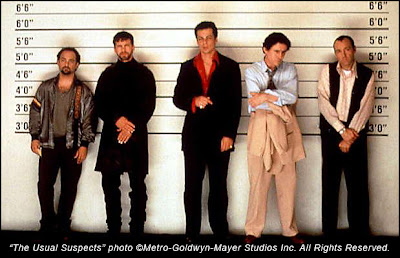
Start by picturing one of the most straight-forward, flat, unemotional, boring visual scenes out there: your typical police lineup. Here's a very well-known example:

Now, just for a second, try to ignore the fact that these are Hollywood actors projecting oddball personalities as part of the plot of the movie. If these were just your "average Joes" rounded up and used for a standard police lineup, trust me, this would be a very boring picture.

As I'm sure you realize, a police lineup intentionally lacks any kind of visual style. It is evenly lit, the subjects are evenly and symmetrically spread out, standing straight up and looking eyes forward, expressionless. They are all the exact same distance from the viewer. Everything is in focus. It's sole purpose is to impart clear and accurate information to the viewer.

Ok, now the fun part. If you start with this bland composition, any deviation from it will result in a stronger and more interesting photo. Think about that...

So, take your pick. Raise or lower your camera angle? The shot gets stronger. Angle your background so it recedes into the frame? The shot gets stronger. Group multiple subjects closer to one another asymmetrically or at different heights or distances? The shot gets stronger. Have your subjects interact and show emotions? The shot gets stronger. Throw parts of your scene out of focus? Move your light source around? Well, you get the idea...

That's really all there is to it. When you pose your subjects in photos, if you're struggling with your composition, try to keep the image of a police lineup in your head, and avoid its compositional pitfalls at all costs. Even if your portrait is of a single person, the visualization will usually hold true.

Class dismissed...

Friday, July 23, 2010

This Month In Style Magazine...

Yeah, July is winding down, but if you know where to look, you can still find the current issue of Lake & Sumter Style Magazine with my fun cover story on the new Tavares (Florida) Seaplane Base and Marina.

Written by staffer Karin Fabry-Cushenbury, the feature showcases a bevy of my photos, including a handful of aerial shots taken while crusing high above Lake Dora hanging out of the open cockpit of a mighty SeaRey seaplane.

My special thanks to the long cast of characters that helped make my job shooting this story both easy and enjoyable: the City of Tavares' Joyce Ross, John Drury, Bill Neron, and John Ruggeri; Roger Kooser and Sherwood Heinman of AL's Landing restaurant (especially for roof access!); Frank Beek for letting me shoot his beautiful 1981 Piper SuperCub featured on the cover, Kerry Richer of Progressive Aerodyne, Inc. for flying me around with my head out the window like a dog on a Sunday drive in the country; Greg Burtner for being my seaplane "model" and patiently following my directions in the sky so I could get some nice shots; and finally seaplane pilot and enthusiast-extraordinare Dan Nickens for helping me coordinate the enitre event and enticing a myriad of seaplane owners to fly in to the base en mass so I could photograph them.

You can read the story and see the shots online: here...

The magazine is free at locations throughout Lake and Sumter County...

Sunday, July 11, 2010

New Updates At STEVENPAULHLAVAC. COM...

Well, it's been a while, but much needed updates have been made to my commercial flash site: www.stevenpaulhlavac.com.  An integral part of my multi-pronged strategy for marketing my work online, sph.com is targeted almost entirely towards publishing creative professionals: magazine editors, art directors, photo editors, production managers, agency directors, etc., etc., etc.

Powered by liveBooks, the site presents a no-nonsense, quick loading, one click, very viewer-friendly slide show format that showcases my images without any of the bells and whistles that serious folks in the industry tend to frown on.  I use it to grab someone's attention instantly, and (hopefully) hold it long enough for my work to make a good impression on them...

Due to the constraints of the site, for the time being I'm limited in the number of image slots I have to use. So chosing the right photos to show is crucial. Right now, I've decided to ease up on the fashion and creative portrait, and concentrate on my editorial lifestyle tearsheets and magazine covers.

Take a look if you will, and let me know what you think...

Monday, June 28, 2010

This Month In Style Magazine...

The June issue of Lake & Sumter Style Magazine has a fun cover story and feature on deep sea fishing captain Jeff Anderson written by Kristina Kolesa. My photos used for both. His fishing charter business is based near Key Largo, but his roots and family are in nearby Mount Dora. A really fun guy to spend time with and (obviously) a ton of fishing stories to tell. The magazine is available free at locations throughout Lake and Sumter Counties. All artwork ©2010 Steven Paul Hlavac and Lake & Sumter Style Magazine.