Showing posts with label art. Show all posts

Wednesday, June 18, 2014

'Photo Asylum Moving Pictures' - Audio Track Promo

As I prepare to publish the teaser this Friday for my current motion project (a behind-the-scenes video of photo artist Kareen Rashelle's Fairy Tale Series Photo Shoot), I wanted to take a moment to address a crucial aspect of filmmaking that often gets overlooked: the audio element.

Below is a video I currently have on my Vimeo page. It's the teaser mentioned above, but the actual footage is intentionally missing and replaced with narrative text to allow the viewer (listener?) to actively concentrate on the audio soundtrack, and better understand it role in the process.


Photo Asylum Moving Pictures Audio Promo
Kareen Rashelle's Fairy Tale Photo Shoot BTS Video

In this instance, I used SONY Acid Music software and some wonderful loop collection music clips to build a melodic, yet haunting aural picture that emphasizes the emotion and tension of the teaser footage, and hopefully makes you anticipate and want to watch the actual video when it comes out.

I'll go into much more detail in an upcoming blog post of how I choose, create, and edit not only the music, but also the dialogue (there will be interviews in the behind-the-scenes video), as well as ambient sound and additional noises and efx I choose to include.

The reasoning, both of this promo as well as future posts dealing with the subject, is to make clear my skills with audio, and showcase my ability to include that as a valuable service provided by 'Photo Asylum Moving Pictures'.

In an interesting twist, I think of this audio promo as a sort of teaser to the teaser that will follow in a few days.

BTW, the idea of revealing a project piecemeal (the full video coming this summer) is one that is currently used on nearly all levels of commercial art, be it movies, videos, music, or books. It is all part of marketing my creative work to the public, social media, and hopefully clients and potential clients.

As always, I invite you to subscribe and follow me on my video sites, and feel free to make comments or ask any questions that come to mind...

Monday, September 23, 2013

Photo Asylum 101: Five Types Of Weather. If You Don't Like The Shooting Conditions In Florida, Just Wait A Few Minutes...

"If you don't like the weather in New England, just wait a few minutes..."  

~Mark Twain


Obviously, my post title today playfully paraphrases the famous humorist, as I believe his quote most definitely applies to the Sunshine State as well.

I have never believed that there is a single perfect type of weather for outdoor photography. That's a myth that tends to be passed around more by beginners and hobbyists than professionals. I love all kinds of weather, have shot in all kinds of weather, and have learned that all kinds of weather have their advantages and challenges, and all can be "perfect" for what I shoot most: fashion and portrait.

From an artistic standpoint, I break down the weather for my outdoor shoots into five basic types:
 
full sun - partly cloudy - partly sunny - overcast - rain
 
Yeah, I know, it doesn't take a genius to figure this out. In fact, I seriously doubt I'm telling you anything you do not already know. Still, sometimes one needs to explain useful things by first being a master of the obvious. I like starting points that everyone can relate to.

My real message is this: to better your craft, you need to try to understand how photographic elements such as light, shadows, contrast, brightness range, color, tonality, and detail are determined and affected by the various types of weather.

As far as I'm concerned, there are two major factors when dealing with the weather. One is in the previsualization, or planning stage of a shoot. I have many different photo ideas that are particularly suited to specific types of weather and outdoor lighting. Even when I use a flash on location, I still consider the general scene illumination from the sun and sky when I figure out how to set up a shot.

The second factor, and this is probably a much more needed skill for a shooter, is to understand how to change set ups and technique at the drop of a hat when weather conditions are different or change quickly from what you had originally planned. You shouldn't just have a Plan B, but also a C, D, and E, depending on what you encounter and how it evolves.

Not only can you learn to use this to your advantage when you plan the looks and style of your shots, often pairing image ideas to the existing weather conditions on location, but more importantly, you eventually realize you can adapt to weather that is volatile and quickly changing without having a nervous breakdown on the set.  Those of you (like me) who shoot outside in Florida know exactly what I mean.

This confidence of handling whatever big momma nature throws at you becomes much more important if your goal is to shoot commercial work, where budget or time constraints often mean scheduling a reshoot is not an option.

Don't be fooled by those who only define professional based on the style or quality of someone's work. Sometimes, especially in the eyes of a client, the only factor that makes someone "professional" is that they come through with the goods: they deliver a promised product on time without making excuses.

My mantra has always been this: the more bad habits and mistakes you can remove from your shooting, the higher the quality of your work will be. Knowing how to recognize and work in various types of weather almost automatically improves your shooting. It will certainly make you more professional and reliable.

What follows is a mix of images, some of which I planned and waited for a specific type of sky and light, some of which I simply looked at what I was getting at the time, and set up and shot accordingly.

full sun
I actually don't encounter this too often in my neck of the woods. I'm a cloud guy at heart, and very thankful that Florida usually offers a dazzling array of fluffy white in all shapes, sizes, and colors, especially in the summer. Still, from time to time, whoops...there it is. Nothing but clear blue sky. So, I use it, and by that I mean I try to darken my skies a bit to give them a decent level of color saturation. This may mean underexposing a tad, or shooting multiple exposures to do an HDR effect, or burning the image in post. For me, plain blue skies are bad enough, but plain white skies are far worse.

Unless you live in an area with a lot of air pollution, you will always get bright directional light with stark shadows. This graphic style can be used to great effect, with shadow play pretty much determined by the time of day and the angle of the sun.

Plain, cloudless skies may seem boring, but sometimes they add to a scene. In this shot, I intentionally centered the horizon against conventional wisdom to create an almost mirror effect between the sky and the water. The SeaRey aircraft breaks up the symmetry nicely. it also hints at the stunning view a pilot must get flying around on a clear day. Photo for Lake & Sumter Style Magazine.
partly cloudy
Partly cloudy is what most of us will get a lot of the time, depending of course, on the time of year and the time of day. In Florida, I can often do a 360° and find different cloud coverage in different parts of the sky. It's usually not too hard to find a patch of blue that is mostly sunny. Partly cloudy skies have a normal or average feel to them for obvious reasons: not as empty as cloudless, not nearly as exciting as dramatic storm clouds.

I like partly cloudy skies when I'm shooting lifestyle or traditional environmental/outdoor portraits where I don't want the sky to distract too much from the subject in the shot. As you can see from these examples, sometimes pleasant is just right.

Sometimes it's good to be lucky, especially if reshooting is a pain. For this story on Central Florida cowboys, I spent most of the afternoon riding around on a jeep with no real game plan, just taking spontaneous shots of life on a working ranch. Both I and magazine Creative Director Steve Codraro were thrilled that at the end of the day, I captured this "Marlboro Man" portrait of cowboy Coy Mueller that ended up as a cover. Nearly any kind of sky would have sufficed, but I really preferred a late afternoon sun with just a hint of clouds in the background. For once, nature cooperated. Location: Oxford, Florida.

Another good example of the photo gods smiling on me. This cover shot for Lake & Sumter Style Magazine was done far enough ahead of my deadline that I could have reshot if needed. I treated it as a full-blown fashion shoot and I had the luxury of including a rain date if the weather/lighting wasn't right. Fortunately, it was. Everything was exactly as I had visualized it when I first planned the shot. A few small wisps of colorful clouds was all I wanted to break up the lazy sky. A ton of large, highly dramatic, ginormous storm clouds in the background would have distracted visually from our beautiful model.  Model: Gloriann Brogden. Hair: Ryan Bogard. MUA: Kristin Moulton. Creative Director: Steve Codraro. Location: Mount Dora, Florida.
partly sunny
Partly sunny, or mostly cloudy (if you like to play with semantics) is also very typical in Florida in the summer. In my book, that doesn't mean there is no direct sunlight or brightness in the sky, it simply means there are a lot of clouds out there. And depending on the wind, they might be moving all over the place, including covering all or part of the sun, just not for very long. So a lot of times this becomes a game. I meter often, and prepare to change my camera settings to match the light. I'm speaking, of course, about shooting on manual, which I almost always do. If you use a priority mode, your life may be a bit easier.

Still, quickness has its virtues (as does patience) to get the shot to look the way you want or planned. I tend to be stubborn that way. If I picture specular light in my mind, I want direct illumination. If I'm thinking diffused, I'll wait for the light to get softer. Hopefully, we all find a way of working that suits our style and partly sunny skies has a little something for everyone.

Partly sunny mean a lot of clouds, which are often unpredictable. As the sun peeks in and out, your exposure changes, and that can be a challenge. Frequent metering is a must. Here I simply go with the flow, shooting model Robert Pate in business attire using the emerging sun as a giant key light. I take advantage of the multiple clouds and add them as elements in the window reflection. Fashion test. Location: downtown Orlando.

overcast
Overcast can mean a lot of things. Again, semantics. What I mean are flat gray cloudy skies that remove the blue sky and direct sunlight from the equation. This is not the same as a white sky caused by overexposing the scene on a bright, sunny day. On overcast days, your subjects will be bathed in a beautiful soft light, contrast will also be soft, colors can actually be vivid, and most importantly, image details will be at a maximum, as the brightness range will be compressed.

Where I live, you cannot depend on this type of sky. Some days it is just there. With that in mind, I always have a plan or idea to setup and shoot when I know there will be no hard shadows. Often it doesn't matter, but there are times when that style is much more emotional, melancholy, or even romantic. I may use very weather-specific wardrobe or props to take advantage of the low contrast and increase in image detail.

Completely overcast skies make it a whole new ball game. Think of the sky as a huge soft box overhead adding a massive diffused light to your scene. That can be amazing if it's what you want. Now, I was going to shoot this idea no matter what the weather, as it was our only chance to work with a monstrous Chinese dragon, but when I realized there would be no direct sun, I decided on a colder and more moody vibe to the photo. The low shooting angle gave it scale, and the soft shadows meant the composition and muted colors would dominate the image. Fashion test. Model: Lindsey Palmer, Elite Atlanta. Hair: Lori Jurgensen. MUA: Sophie Loock. Location: Splendid China, Florida.
rain
I'm going to lump rain and heavy dramatic clouds together as they are often both there at the same time. As many of you have discovered, it only takes the blink of an eye to go from a majestic backdrop for your scene to a torrential downpour that threatens to ruin everything, including expensive equipment.

I won't address actually shooting in heavy rain, as up to this point in my career, I can't really remember ever doing that. For anything that involves a lot of time and work on styling, hair, and makeup, when the rains come, I call timeout and we wait. Or move indoors to shoot. Or reschedule. 

Don't get me wrong. I love the rain. As a person. Love rainy days, especially when I lived by the ocean. Love being out in the rain. It just doesn't seem to mix with my photography, though. Maybe as I get further into filmmaking, I'll decide to shoot rain scenes, you know, for the drama and emotion. Until then...

Still, a few drops never killed anyone, and many times (again depending on the wind) a light sprinkle will come and go as you shoot. And come and go. And...well, you get the idea. 

If you find yourself in these kinds of conditions and situations, you should really develop a sort of fire drill that gets your crew (and model and wardrobe) in and out of the moisture as quickly as possible. You also should have a game plan if you decide you want to work in a light rain, making sure everyone knows how to keep the gear and talent as dry as possible. Time is money, and wasted time is a photographer's enemy. A little forethought and talking to those working with you on a shoot ahead of time goes a long way. It may make the difference between a complete washout (pun intended) where nothing is accomplished, or ultimately being productive.

Don't be fooled by the glint of sunshine sneaking through in this behind-the-scenes photo. This late afternoon in Central Florida was almost completely cloudy. So, not only were we running out of daylight, but guess what? It started raining as we tried to work! A photographer's nightmare. Harpist Nici Haerter was not only extremely professional, but actually refused to take her expensive, beautifully carved wooden instrument out of the light rain because she knew we needed to get the shot! As you can see, she decided to cover it with a towel until I was ready to shoot. Photo for Pulse Magazine. Hair: Ryan Bogard. Location: Eustis, Florida.
So, you see what I did? I started off with a handful of mundane comments you all figured you knew all about. Then, as I added details and situations and all kinds of good stuff you need to consider to create really strong photos, hopefully I made you realize things are often not as simply as they seem, and circumstances can change in an instant. You need to learn to be ready, and adapt.

Trust me, all it takes is screwing up even one commercial or personal shoot because of a weather condition you didn't even consider, and you'll find you'll start taking something the average person takes for granted much more seriously. I hope I helped...

Saturday, September 21, 2013

Look Ma! No photos! What the???

As I take a quick look back at some of my blog posts, I can't help but notice that a whole slew of them are simply written themes or ideas without any accompanying images. Obviously, this was not planned, and I know a photographer's blog should be very visual, but there are several good reasons for this.

The main one is time. Some of the ideas I've had for posts were just short thoughts or announcements that I wanted to post immediately due to their time-sensitive nature.  Not only did they not especially need photos to go with them, but (at least for me) editing images to add to a post is time-consuming.

Because of this, it seems I've been putting off many of my more extensive and interesting ideas and tutorials because I haven't taken the time to arrange and edit the many photo examples I need to illustrate what I'm trying to say or get across.

So, I guess what I'm trying to say is I will make it a priority to start posting ideas and topics that include a variety of pretty cool images to clearly show what I'm saying.

After all, isn't that really whatchu whatchu whatchu want???

Tuesday, August 13, 2013

Then One Day The Smithsonian Called: Why You Should Always Save And Archive Your Work!

Well, it took a while, but one of my photos is finally in the Smithsonian.

It's true. I tell you no lie...

Now, it is not in the permanent collection and on display in a museum in Washington, DC for all the world to see. I wish. Rather, it's a portrait I shot of painter Carlos Alfonzo in December, 1990, originally appearing in the publication Miami New Times Newspaper. And it will be used as part of a printed catalog to coincide with the exhibit:

 Our America: The Latino Presence in American Art.


My photo of artist Carlos Alfonso (Cuban, 1950-1991) in his Miami studio, 1990.
Now, I am not the most organized guy in the world, and when it comes to my photography, I have a whole mish-mash of storage systems. Most of my digital work is, of course, logically filed on hard drives and on discs. Oh, and for the most part, key worded. Finding things in the computer age is not usually a problem.

It's my film originals that I probably need to work on a bit. Fortunately, many of my older negatives are neatly stored in chronological order in binders with their labeled proof sheets, and yes, the bulk of my color film slides are in boxes or pages, generally safe, in one searchable place.

Good thing, too.

Because one fine day, I was minding my own business, when out-of-the-blue came an email from an Emma Stratton, Permissions Coordinator, Smithsonian American Art Museum. Now when Ms. Stratton comes a calling on behalf of the Smithsonian, you pay attention.

And so, I paid attention...

And what she asked me oh-so-politely was if she could use my image of Alfonso for the upcoming Smithsonian exhibition catalog. Luckily, she had seen it used before in another catalog for another exhibition at the Miami Art Museum in 1997.

Obviously, I said yes. That was the easy part...

So, after agreeing to the deal, and excitedly shouting to anyone within earshot, I actually had to get down to business. I needed to track down the original negative, make a quality scan, create a digital file in photoshop, edit and retouch that file, then output it in a size and format that met their specifications for the printed catalog. Oh, and get it to them.

All on deadline...

In the end, it was not all that difficult, but without finding that original negative fairly quickly, I most likely would have been screwed.

Which brings me to my point: you need to develop a system of organizing and cataloging your images as you go along. Something that makes sense when you're trying to find an individual photo many many years after it's been shot.

Now, I had no way of knowing that Carlos Alfonso would sadly die not long after he sat for my camera. Nor could I ever imagine what his place and fame would be in the context of Hispanic and American art, or what the demand would be for a picture of him many years later.

But, because I was disciplined enough over the years to keep most of the rolls of film I shot together in pages with their proof sheets in books chronologically in a protected cabinet, I immediately and confidently told Emma Stratton I could send her artwork. I knew it would not take me long to find the negatives from our 1990 portrait session, even in the year 2013, and it didn't.

In this digital age, it is very tempting to simply live for the moment, shoot what we want when we want, and assume the computer will keep it all organized. In a perfect world, maybe, but if you value your work, you really owe it to yourself to pay much more attention to organizing and archiving your images in a way that makes sense.

After all, you never know when someone from the Smithsonian will come knocking on your door...

Friday, July 5, 2013

Happy New Half Year! And So, I Begin Anew...

Ok, I'm not the kind of guy to make a lot of resolutions on New Year's Eve.  Yeah, I try to clean up my act, good intentions and all that, but I purposely keep those kinds of promises to myself fairly vague, so I don't feel so bad when I blow them off.

I do however, believe in the power of the calendar when it comes to planning the goals in my life.  I'm not really astrological in the spiritual sense, you know - the whole fate and destiny kind of thing based on the alignment of various heavenly bodies and all that, but I do (like a lot of people) think that the beginning of a day, or a week, or a month, or a year makes a logical starting point for my various life activities, especially if I plan on making changes to them.

In this case we are talking about the start of July: the beginning of the second half of the year 2013, and I know and feel this moment has a great significance.  It will mark the first time in over a decade that I can devote my time and energy and resources full-time to my career as a photographic artist.

And so, without giving a boring history lesson on hopes and dreams in the past that I was unable to accomplish for a multitude of reasons, let me just say most all of my shackles have been removed, my career and business begins anew, and we are all finally going to find out what I am capable of.

By the way, not to brag, but working only part-time with a great many constrictions placed on me by my family responsibilities and inability to travel, I was still able to snag a handful of photo award hardware in the time I've been up here in Central Florida, including one Editorial Magazine Cover of the Year in 2006 in a national competition.

I also managed to keep my gallery resume going with an assortment of group and one-person exhibitions at various venues and times throughout the area since I've lived up here.

Not bad for a guy with one hand tied behind his back...

Now, I don't know about you, but personally, I cannot wait for all the good things that lie ahead! Wish me luck!

Monday, July 1, 2013

Now, Where Was I Before I Was So Rudely Interrupted?

"The road to hell is paved with good intentions" ~ancient proverb

"From life's school of war: what does not kill me makes me stronger" ~Friedrich Nietzsche


Well, I have to tell you, I really thought my spring would be more productive. And while I did indeed have the best of intentions of getting a lot of things done, life -in its inimitable way- threw up (and yes, if you want to take that literally as gastronomical, feel free) a few unexpected road blocks that I had to go around. Or maybe they were hurdles I had to jump over?

Ah, "hurdles" might actually be more accurate, as I certainly do not jump any where near as well as I used to!

Regardless of semantics, it's involved challenges galore, and they were (and are) obstacles that made me not only rethink the way I worked and organized my career, but had me questioning my very life as well.

The major event, on February 10th (a date that will live in infamy!) happened only a few days after my last blog post. Without going to great lengths to explain the details, suffice to say it was a major medical event, and had me laid up in the local hospital for over a week.

Now, those of you who follow me on Facebook have probably already read a lot about this ordeal, as I've made quite a few posts on both my personal page as well as my photography fan page.

The good news is I seem to be basically fine, and well on the road to recovery. Hmmm, come to think of it, if I'm going to use that analogy, maybe these are roadblocks after all.  The bad news is my balance and equilibrium are still a bit hinkey, and continual physical rehab seems to be the order of the day. So, while running and catching a thrown frisbee is probably a no go for me, I am back to driving, and working out, and most importantly...shooting a camera! Believe me, there were times during the last five months I wasn't even sure I would ever do these things again.

Thankfully, my LIFE INTERRUPTED, however briefly, is moving forward again!

Speaking of thanks, again I cannot thank my friends, family, clients, and acquaintances enough for all the support and well wishes I've received recently. The positive vibrations and white light aimed in my direction has had a profound effect on my progress and motivation!

So, let me end this post the way I began it:

Where was I before I was so rudely interrupted?

Yes! That's right! Now I remember! More to follow...

Wednesday, February 6, 2013

My Return To A Full-Time Career In Photography: The Teaser...

I tend to see both sides of most issues. I weigh the good and the bad when I make decisions. I look at strengths and weaknesses when I evaluate people and situations.

And so, when it comes to the idea of (hopefully) having a full-time career as a photographer again, I cannot help but think of two things.

The BAD news is: it looks like I will have to start over almost completely from scratch.

The GOOD news is: it looks like I will finally get the chance to start over almost completely from scratch.

Well, there you have it. In those two sentences you get a glimpse at both my excitement as well as my anxiety about the big changes to my life and career that will most likely begin this coming spring.

Wish me luck...

Saturday, June 2, 2012

Back to The Blog!

Oh my. Has it really been that long?!? It's hard to believe. Impossible to believe. And yet, in the back of my mind, I know I've been putting off, and putting off, and putting off posting here, and the excuse...er, I mean the reason is pretty simple...

It's not that I have nothing to talk or write about. Heaven's no! I could talk all day. It's just that I post so many updates on my Facebook Page (link to the right, if you wanna join) on my shoots, my published work, my artwork, and just about everything else photographic, that I guess I've been rationalizing that that pretty much covers things.

But it doesn't. Yeah, I'm well aware that blogs in general are losing viewership, mostly because the majority of them weren't that interesting to begin with, and (as I can attest to) it takes a certain amount of consistent effort to post to them regularly.

But I think in the end they serve different audiences. At least a traditional blog like mine. It's a venue where I can address projects and issues and go into a lot more detail. Not just the "quick fix" that Facebook provides...

Maybe I'm wrong, but I'd like to think the viewer that makes the effort to come here and see what I have to say has a slightly longer attention span, and doesn't freak out at the likelihood of multiple paragraphs strung together to flesh out a theme or make a point.

And so, let me use this post to recommit to getting back to blogging and keeping things timely. And frequent!

See you soon!

Sunday, July 17, 2011

Photo Asylum 101: Symmetry Is Not A Four Letter Word.

Photographic composition can be a rather intimidating subject, at least when you're trying to learn to separate right from wrong, so you can get better at your craft. It's possible to find an almost unlimited amount of advice and opinions on what the rules of composing your pictures should be. And then when you consider that on any given occasion, most of those rules can be interpreted, stretched, broken, or simply ignored, the whole process can overwhelm the inexperienced photographer in a hurry.

What gets me are those that are rigid in their "rules". They try to make you think you need to conform to some sort of ancient code of honor carved in stone, and if you dare stray from it, your work will suffer immeasurably.

I, on the other hand, to quote Pirates Of The Caribbean --figured they were more actual guidelines-- and have always felt a bit of flexibility is in order. My shooting technique is relatively traditional, but definitely allows room for some "departures" from the norm in the name of style. I have always taught or given advice on photo composition with that philosophy in mind...

A perfect example of this is the idea of symmetry in a photo, which for the sake of this post, will loosely refer to centering a subject in the scene, or having nearly identical visual elements on opposing sides of a scene positioned horizontally in a mirror-like manner. Still with me?

Centering your subject, or having too much symmetry in a scene is often looked down upon by photo purists, as it is in direct violation of the magical Rule of Thirds or Golden Ratio. I'll let you do your own research on those two scared cows.

But I say nonsense! There is no good reason for you to place such arbitrary restrictions on your creativity.

Let's be clear: like many, I strive for an asymmetrical balance in the majority of my work, and if you're familiar with my shooting style, you know I love having visual elements receding into the frame or extending through it at all sorts of interesting angles to create a sense of depth and movement.

People especially are rarely placed in the exact center of my photos...

But IMO centering and shooting symmetrically is not evil, despite what many experts say. It should be considered a welcome change of pace for any photographer. You simply have to have a sense of what you're trying to express with this type of composition, frame your shots thoughtfully and carefully, and try not to be too repetitive.

Let me illustrate what I mean by showing some shots from a fashion test with Chicago model Adrianne Michelle (hair/mu: Stacey Lynn). We found a great location at the Illinois Institute of Technology in Chicago where the outside light was filtered through these heavily tinted orange windows (the color you see is redder, and was enhanced in post).


blogger-symmetry1
A symmetrical composition.

Because it was so easy to set up a symmetrical scene by placing the chair between two window frame sections, I decided to start out by posing her in symmetrical poses as well.

And that's one of the best reasons to center your subject and shoot symmetrically: to accentuate that visual effect and make it clear that was your intent. BTW, this is neither here nor there, but if you were observant enough, you may have noticed that's also Adrienne up top in my blog banner. Same shoot. But I digress...

One cool thing you can do with a symmetrical scene is easily create a bit of visual tension and interest by positioning one or more elements or subjects in an asymmetrical position within that scene.


blogger-symmetry2
A mixture of symmetrical and asymmetrical elements.

Above is Adrienne demonstrating exactly that. Same basic camera angle and scene position, which means that most of the shot will still be symmetrical. But she changes her pose, and that makes a huge difference.

BTW, I often go through this routine in many of my shoots. I have a sort of fascination with human symmetry, even if it doesn't make its way into my final images, and many times I'll start the model out in a symmetrical pose, then move on to other things. It's a good visual and posing "warm-up". FWIW, if you're a model, a valuable exercise is to practice moving slowly in a strict symmetrical fashion. It's more challenging than it looks, and may help you out during your shoots.

Now, maybe you don't shoot fashion, or maybe you don't especially want the symmetry of a shot to jump out at the viewer as a style element.

Never fear. Symmetrical compositions work fine in portrait work as well, and they don't have to be rigid. In fact your shots will probably more effective if you soften the rules just a bit.

The portraits below illustrates an important guideline for centering your subject: try to use the environment or man-made structures, or even other people in the shot to frame the person.


flickr-blog-portrait-symmetry 
Symmetry can work nicely in portraits as well.

In both of these magazine portraits, neither the pose of the subject nor the background areas are perfectly symmetrical, so the effect is a bit more subtle. I also added a slight horizon tilt on the left that was part of my shooting style at the time. Not everyone's cup of tea, so shoot that sort of thing as you see fit. Oh, and if you're thinking the sky on the right looks a little washed-out, keep in mind the publication placed type there for the cover.

So, never let anyone make you feel guilty about centering your subject, or using a symmetrical composition. Just be sure to do it carefully, and with a sense of purpose, and you'll be fine...

All photos ©Steven Paul Hlavac.

Monday, July 11, 2011

Photo Asylum 101: Holy Crop! Photographers PLEASE Keep Those Model's Hands And Feet inside the frame!

As I look at much of the fashion photography being posted online by younger shooters (and this is mostly self-publishing, not actual magazines), I'm a bit stunned by the number you that don't seem to have a firm grasp on the fine (and I have to assume elusive) art of cropping an image.

As a photographer, you have three opportunities to crop a photo. Once when you compose in the camera. Again when you crop making the print in either a wet darkroom or on a computer. And finally when you present a printed photo by trimming and/or window matting it.

Now, in a sense, composing and cropping an image go hand in hand, as they are essentially the same thing. By cropping, you are altering the composition of your shot. Obviously, the nice thing about cropping is you can do it after the fact, often correcting mistakes or making the composition of a pic stronger after you've had time to look at and think about it.

And much like the art of composition, the full art of cropping is way too encompassing to get into here. So I'll simply deal with one small aspect. One tiny, yet incredibly annoying aspect of cropping fashion photos that I spot with disturbing regularity: cutting off your model's hands at the wrists or feet at the ankles.

Now, let me be clear: you have the right to pose your model, then compose your frame and eventually crop your shot in any way, shape, or form that you see fit. Far be it from me to tell you how to create your own art.

But I see things through the eyes of someone who's shot editorial and advertising work for a lot of publications, and worked with many Editors and Art Directors over the years. To have your work accepted and respected in a larger and much more critical world, you can't just have a free-for-all going on in your photo.

Random doesn't usually work. The way you crop is critical to whether the image is successful or not, and in the commercial world, other people's opinions do count.

Think of it like this: you can drive your car like a madman in your own back yard to your heart's content, but at some point, if you decide to venture out onto the street in the real world, you need to know the "rules of the road", because they do exist.

So, with that in mind, let me start by saying arms and legs at the edge of a frame with either the hands cut off at the wrists or feet cut off at the ankles tends to look really bad.

Really. Bad. Whether you realize it or not...

So, assuming you do not want a full-length shot, where do you crop? Easy. You crop much further up the arms or legs. When you do that, it appears to the eye that those body parts are simply out of the frame. Nothing unusual.

On the other hand, when hands and feet are cropped at the wrists or ankles, it actually appears that those parts are missing, and makes the overall composition look very awkward, or even freakish.

To our left here is a perfect example. Our beautiful model Lucy Marchany (agency: Wihelmina New York) has graciously volunteered to let me slice and dice her lower extremities at various spots in the interest of advancing cropping knowledge for all humanity. What a sport. In return, I promised to buy her new boots. I'm sure you can see the irony...

Now, the shot on the left is properly cropped. A symmetrical composition cut off just above the knees. It looks perfectly natural, what we would call a three-quarter length shot. There is enough of her legs out of the frame that our eyes don't even think about it. They instead concentrate on the part of her that we can see.

The pic on the left is poorly cropped. Lucy's legs lead the viewer's eyes all the way down to where her feet should be. And because of that, you expect to see her feet. When you can't, it seems as though they've been removed. Taken away. Missing. It looks unsettling.

Here is an example of the wrong and right way to crop a model's hands in a shot. Poor Chevonne in the first pic looks like she was involved in some horrible industrial accident that lopped off her left hand. And she's married no less. You can imagine her anguish. Russian beauty Svetlana on the right has her left arm flow smoothly out of the frame, the crop done much higher up the arm and at an angle.

Now, as much as I try to refrain from pointing fingers at any specific individuals with these "lessons", I feel I have to mention a photographer whose online book I viewed recently. Not by name, of course...

They had many shots of extremely attractive models in some very good poses, but almost all of the pics have the poor girls' feet cut off. Yep, you guessed it: at the ankles. It was so odd because it was done so consistently throughout their portfolio. As I've been saying, it would have been much better to either show the models' feet entirely, or crop much higher up on the legs.

What's even worse is many of the shots gave credit to a Wardrobe Stylist, making it quite bizarre, as this stylist was either too lazy or didn't have the resources to pull shoes for these shoots (shoes obviously being one of the most important styling elements of any fashion shoot). Either that, or they simply didn't care that their hard work was eventually cropped out of the photos.

My point is even talented shooters can show they are completely clueless about certain things, and this obvious and easily fixed issue, IMO completely ruined their portfolio. Much like my initial reaction, an Art Director or Photo Editor would cringe viewing the work.


So class, pay careful attention to your in-camera composing, and especially your post-process cropping. Let's either keep those hands and feet safely inside the frame, or crop them out the correct way...

All photos ©Steven Paul Hlavac.

Monday, July 4, 2011

Get Ready For PHOTO ASYLUM 101...

Now, I know for many of you, school is out for the summer, but here at The Photo Asylum, the learning process never stops. Never...

And so, I'll soon be starting a series of blog posts under the common heading of Photo Asylum 101.

The subject matter of these posts will vary widely. Any and all things relating to photography including lighting, shooting, pre and post-production, composition, studio and location gear, presentation, you name it.

Also, various aspects of the fashion business, specifically as they relate to organizing and producing fashion shoots. Styling, casting, location scouting, video, etc.

Sometimes these posts will start with a particular criticism. Something I see being done wrong or poorly. The emphasis will never be on the negativity of the mistakes or the bad habits, but rather my suggestions for perhaps ways of doing things a bit better. Persuade rather than admonish.

Other times these will just be straight-forward, short tutorials, simply explaining a rule, technique, or way I've learned to do something that I want to pass along. Again, a suggestion. Just something for you to consider.

My intention will always be to improve your way of working, and as with most things in life, you are free to embrace or ignore my advice.

So, get ready. There will be a test at the end of the semester...

Thursday, June 30, 2011

An 'Image Creator' No More: My New Photography Business Plan - Part 2

PLEASE NOTE: this is Part 2 of a two-part post (eh, hence the name). I strongly recommend you read Part 1 first.

Let me resume my discourse on the demise of the "image creating" business by first admitting I pulled a Jedi Blog Trick in that first post. I painted a dire, dramatic sky is falling picture of the photography business that may have startled some. While fairly accurate, it only gave you a tiny piece of the big picture, and represents just part of a much larger industry.

The ASMP Director Eugene Mopsik commentary column I quoted from is aimed (as is ASMP itself) primarily at commercial editorial and advertising photographers whose main income comes from licensing their published work.

These are the professionals who are most in need of re-inventing themselves. The group that is seeing their older, traditional business plans crumble as a result of the digital imaging revolution. Over the years, much of my work has fallen under this category.

There are many other types of photography-related businesses and careers. For those of you moving along a slightly different path, you may find that opportunities abound, and the health of your niche in the imaging world may indeed be robust. It is, after all, a very complicated and fluid business.

To reiterate the main point of Mopsik's column, for this specific group of photographers:

Survival is contingent on the establishment of multiple income streams...

Now, this advice fits me to a T, and it is exactly where my head has been "at" for quite a few years now. It is just reassuring to see it spelled out by a respected industry professional. Makes me feel I'm not alone in this battle.

So, with that in mind, here is my New Photography Business Plan, which as I just said, is not really new, but as we enter the second half of 2011, is worth re-focusing on.

FASHION - This is one of my biggest gambles. I have not shot a serious editorial fashion project in over five years. That's an eternity in the business, and it's due in part to the poor market (and attitude) here in Central Florida.

Still, I think enough progress has been made here recently that, with all the great shoot ideas I have rattling around in my head, the time has come to have another go at it. The plan is to test, shoot for Style Bedlam Magazine (see below), and hopefully that will lead to editorial and advertising print work. I feel my renewed effort will either open up the floodgates to an exciting new chapter in my career, or end up just being another lesson in futility.

VIDEO - This what really has me psyched, and it ties in nicely to my return to fashion. Still shooters have been making the transition to video for quite some time now, and if they haven't already, many will need to eventually in order to survive.

I am not freaked out or intimidated by this in the least, for reasons I will cover thoroughly in a future blog. Let's just say that my years of storytelling and thinking cinematically with my still work gives me many of the skills needed to direct and produce motion. I don't see this replacing my still shooting, but rather supplementing it.


STYLE BEDLAM MAGAZINE - An enormous web project for the fall of 2011. It ties in directly to the two things listed above. Starting my own online publication, however humble, is the ultimate self-assignment experience. I am trying to make this a complete magazine with fashion editorials, music and art features, and whatever the hell else I can throw in there that's slightly off-kilter. It will hopefully provide the perfect vehicle for me to network and collaborate with creatives from many different fields and markets. And, it will serve as my premiere marketing tool.

STOCK PHOTOGRAPHY - I hate stock photography. I have always hated stock photography. It is the polar opposite of everything I have learned to shoot over my career. Most stock is generic and anonymous. And in this micro stock market, it pays pennies. That being said, in today's WWW world, and considering the vast amount of archive images I have, plus the fact that most micro stock web sites allow you to join for free, it makes no sense for me not to offer an assortment of my photography as stock. A modest amount of effort to set everything up, and the web makes the work available to potential clients 24/7/365.

ZAZZLE - DEVIANT ART - FINE ART AMERICA - ETSY - Despite the lack of success of my gallery work since I've relocated (another strike against Central Florida), it fuels my soul too much for me to give up on it. And so I continually go in search of other, more worthy markets. The web has made that much, much easier. The names you see listed here are all art & design online stores, and they all allow me to easily market and sell my work in one form or another. All over the world. All free (or for a nominal listing fee). Persistence with these sites produces results. Wish I could say the same thing for where I live.

PHOTOGRAPHY WORKSHOPS - I have taught photography on and off in the past, and currently give away a tremendous amount of free advice and information on web forums, my Facebook Page, and now this blog. But there is a part of me that feels I can market myself a bit better and in a more structured environment by offering actual professional workshops. Again, I would tie this in to my fashion and portrait work, with the emphasis on studio lighting. It is very tempting, as I get a lot of satisfaction from teaching, but will require a lot of work on my part as well.

Well, that's the gist of it. I have an assortment of other art or photo-related projects designed to produce income, but these are the major categories that I'm concentrating on. A shotgun approach to be sure, and one that will require a lot of juggling, but one that I am confident will work. And the irony of it all is that I will remain an image creator, and that sure is a relief...

All photos ©Steven Paul Hlavac.

Wednesday, June 29, 2011

'The Mouth That Roared' Is Here To Stay...

In this New Digital Dawn, everyone and their cousin thinks they're an expert on social media and how to use it effectively. Especially when it comes to business.

And, as much as I enjoy hearing a wide variety of opinions and views on most anything, I rarely take someone's advice on such important matters at face value. Rather, I kinda soak it all in, repeat my mantra of "consider the source" a few times, then try to decide if it makes any sense for my situation.

Many of us have very different business and career goals, so a blanket or one-size-fits-all policy on how to harness the vast array of social media resources out there is rarely going to be the best one to latch on to.

Yet, every so often a precious nugget of wisdom that would appear to be universal rises to the surface, so I greedily grab it with both hands, and simply wonder why anyone would not want to add it to their toolbox.

What am I talking about? A quote from a true social media expert (at least IMO) that basically gives me the green light to do what I do best, and tells me I will very likely be more successful for doing it.

Now, I must apologize, as I cannot remember where I read this or who even said it. I know that's bad, and I would love to give them the credit they deserve, but truth is, for the sake of this post, it doesn't really matter.

And so I will paraphrase heavily...

This person basically said that the key to effective use of social media is to have an impact: project your knowledge and personality in a fun and large way that sets you apart, gets people's attention, and makes them want to participate in what you have to offer.

Fun and large way. Makes them want to participate. Interact. Establish a dialogue...

I know what you're thinking. How is that profound? Everyone offers that advice. It's just common sense. True, but I haven't gotten to the profound part yet.

This person goes on to say that the single biggest mistake someone can make using social media is to abandon that boisterous voice and softly water down their message in an attempt to be all things to all people.

Water down their message in an attempt to be all things to all people.

As someone who has been guilty of doing that very thing on my Facebook Page, this pronouncement quickly got my attention.

The worlds of commercial and fine art photography are truly wonderful, with great rewards for those that have the talent and the work ethic to stay the course. But they are also highly competitive, often superficial and petty, and absolutely cutthroat at times.

I believe in a strong sense of self and purpose, the art of defending and persuading, sticking to my guns, and most importantly, fighting the good fight when its called for. It's called debate, and I think we are all the better for it when done properly and with respect.

Still, not everyone has the stomach for these sorts of battles, which is why overly defensive and soft and fuzzy I'm OK! You're OK! personalities abound on the web, at least when it comes to photography, with the message that no one should dare say anything the least bit critical, lest we hurt someone's feelings.

My mistaken reaction to this "everyone's photography is awesome" mentality has been to soften my stance, in effect lower my standards so as not to ruffle anyone's feathers, in some misguided attempt to get as many people to like me as possible.

While this game plan did in fact win me many new fans, it also effectively muffled much of my personality and voice, effectively blending me back into the crowd with all the other "nice" people. And in some ways I was miserable because of it.

The world of mediocrity was being shoved down my throat, and I was suppose to muzzle myself and not speak up.

So, you can only imagine how liberating my social media friend's magnificent words were to read and ponder. It was literally a glorious validation of my very heart and soul.

Don't get me wrong. I don't take this as a license to be mean-spirited or hurtful. I have never been, nor never will be those things. It is possible to be critical in a constructive way and still remain nurturing and positive. Trust me on this one...

But what it does is give me permission, better yet, tell me it's my sworn duty to stir things up!

You heard me. STIR THINGS UP...

In my book, yeah that means maybe smacking people around verbally on occasion, but always in a thoughtful or maybe humorous way, the goal being to help those that truly seek it and want to grow in this business. It is absolutely acceptable to point out someone's mistakes in an attempt to help them learn from them.

And so, with all due pomp and fanfare, I hearby declare that I WALK ON EGGSHELLS NO MORE!

Some of you will thank me for this later...

Sunday, June 26, 2011

Photographyreview.com Studio & Lighting Forum Is The Place To Be...

I'm the moderator with my pocket calculator...

Do you use lighting in your photography? Of course you do. What a silly question. That's what photography is. But do you use artificial lighting in your photographs? Well, chances are you do that as well.

If that's the case, I'd like to mention that I moderate the fun and informative
Studio & Lighting Forum on the always spectacular photographyreview.com web site.

The forum is a great place to learn or share information on lighting, as well as all things related to working in the studio. All are welcome and made to feel comfortable, from the absolute newbie to the seasoned, veteran pro. Topics discussed range from choosing new lighting gear, lighting setups for particular shots, inexpensive alternatives to pricey studio grip equipment, and of course troubleshooting individual problems with your lighting or studio setup. Trust me, there's a little something for everyone.

My job, of course, is to keep everyone in line, and to make sure we all play nice. Not too difficult with the great group of members we have on the site. And registration is free...

With my return to shooting editorial fashion in the coming months, I plan on spending much more time on the forum, and will be making it a priority to share my shoots and how they were planned and carried out.

What better time to come aboard and be a part of it?

Saturday, June 25, 2011

"Endeavor To Persevere..."

Sometimes this simple quote is enough to keep me going. Especially considering the original source...

Spoken by wonderful Native American actor Chief Dan George's character Lone Watie in the classic Clint Eastwood western, The Outlaw Josey Wales, it has become one of those larger-than-life movie quotes taken from Hollywood but applied often to real life. George's role in the picture, while played mostly for deadpan comic effect, closely mirrors that of actual American Indians throughout our history.

And so, for him to continually utter the phrase in the face of his monumental struggle, it becomes easy to transfer it and its meaning to the more mundane challenges we face in our modern lives.

Endeavor to persevere. Strive to make the effort. Keep on keepin' on. Never give up. However you want to package the words, they remain a potent reminder.

Not of the solution. But of those first steps towards it...

Thursday, June 23, 2011

Hit A Roadblock With Your Portrait Photography? Let's Round Up The Usual Suspects...

I taught a handful of photography subjects during my time living in South Florida, from black & white film and print processing, to studio lighting, to photo composition and critique. All were satisfying, as they helped open up new worlds to students, giving them tools to further their work, sometimes in surprisingly wonderful ways. But the most enjoyable by far were my classes on photo composition.

Sure, the equipment can be fun, the shooting can be fun, and the process can be fun, but what I tend to cherish most about photography is viewing and talking about photos. My photos. Your photos. Their photos.

And so, with that in mind, I'd like to pass along a little easy-to-remember visualization tool for making your photos (especially your people shots) stronger. I came up with this technique years ago, and it was usually the very first thing I taught my students. Not to brag, but sometimes the improvement of their images between the first class and the second was dramatic. Kind of like flipping a switch. Even if you've been doing this photography stuff for a while, you may find it helpful.

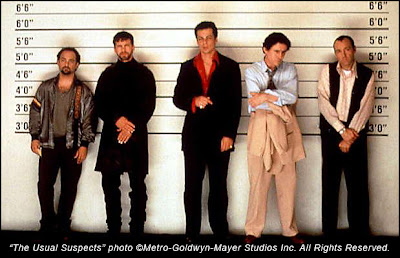
Start by picturing one of the most straight-forward, flat, unemotional, boring visual scenes out there: your typical police lineup. Here's a very well-known example:

Now, just for a second, try to ignore the fact that these are Hollywood actors projecting oddball personalities as part of the plot of the movie. If these were just your "average Joes" rounded up and used for a standard police lineup, trust me, this would be a very boring picture.

As I'm sure you realize, a police lineup intentionally lacks any kind of visual style. It is evenly lit, the subjects are evenly and symmetrically spread out, standing straight up and looking eyes forward, expressionless. They are all the exact same distance from the viewer. Everything is in focus. It's sole purpose is to impart clear and accurate information to the viewer.

Ok, now the fun part. If you start with this bland composition, any deviation from it will result in a stronger and more interesting photo. Think about that...

So, take your pick. Raise or lower your camera angle? The shot gets stronger. Angle your background so it recedes into the frame? The shot gets stronger. Group multiple subjects closer to one another asymmetrically or at different heights or distances? The shot gets stronger. Have your subjects interact and show emotions? The shot gets stronger. Throw parts of your scene out of focus? Move your light source around? Well, you get the idea...

That's really all there is to it. When you pose your subjects in photos, if you're struggling with your composition, try to keep the image of a police lineup in your head, and avoid its compositional pitfalls at all costs. Even if your portrait is of a single person, the visualization will usually hold true.

Class dismissed...

Friday, August 6, 2010

Ansel Adams In Color? Who Knew???

Now, I already know that I'm going to ruffle some feathers with this post, so why don't we just go ahead and get it out of the way?

I am not particularly a fan of photographer Ansel Adams, and looking back, realize I have never been. Don't get me wrong, I fully acknowledge the man as an absolute icon of photographic art, and will be the first to stand up and salute his amazing contributions to both the technical as well as esthetic aspects of the medium.

It's simply the work. His meticulous and mind-numbingly analytical breakdowns of scenic light and exposure, and absolute perfect processing and printing of large-format negatives has neither insired me nor motivated my own work.

I am most defintely from the "deconstruction - reconstruction" school of art, and I've always prefered my images include people (and their emotions), man-made structures, movement, spontaneity, elements of artificial light, and storytelling in lieu of anything purely scenic and natural. And I also think obsessing too much over the technical apsect of photography often takes away from its emotional impact.

My inspirations early on were abstract artists such as Duane Michals, Andy Warhol, Art Kane, and Jerry Uelsmann. When it's all said and done, we are what we are, and are driven by our unique individual passions. I will never apologize for that...

I'll take this blasphemy one step futher. Over the years, I have often looked at the works of Adams, tonal perfection and all, and have thought to myself, "This looks like such an amazing scene. It's a shame the image isn't in COLOR..."

Now, before you start to go round up the townsfolk to chase me up into a tall wooden structure that you plan to set on fire, let me assure you these thoughts were not out of ignorance. Early in my career, my work was almost entirely black and white (both commercial as well as exhibition). And from the time I first learned of it, I fully embraced the Zone System as the primary exposure tool for my film (and now my digital) photography. I adore a monochrome world!

But alas, when it comes to art, I usually go with my gut, and all I can say is that IMHO certain images, certain scenes, just lend themselves more to a color treatment. And to me, stripping this element from a wonderous, majestic, stunningly beautiful natural landscape, no matter how well done, bleeds it of much of its life force and emotional power.

Which brings us to the whole point of today's entry!  Last weekend, whilst browsing my favorite local bookshop on a lazy Sunday morning, I stumbled upon what I think is an absolutely marvelous photo book: Ansel Adams in Color (http://amzn.to/9yUHpj).

It was as if my wish over the years was finally granted...

Now, in all fairness, this is not a new title. It is simply revised and expanded from the 1993 edition. But it is better, the main reason being its image scans have improved, and the printed photos most surely are much closer to what Adams originally achieved in his darkroom or custom lab.

And what photos they are! This was my first time really looking at this work, and as I thumbed through the volume, I was surprised how many of these pictures moved me in a way the black and white classics never did. It's not something I can easily explain, and it's certainly not something I can argue about with a "purist", but in my heart I know I was right, at least from my point of view...

I honestly feel that these "new" images are undiscovered treasures for many photographers and art lovers who only know Adams as a black and white artist, and whether you prefer them to the iconic, traditional versions or not is really not the point. I see it as simply adding to Adams' amazing legacy and body of work...

Sunday, July 11, 2010

New Updates At STEVENPAULHLAVAC. COM...

Well, it's been a while, but much needed updates have been made to my commercial flash site: www.stevenpaulhlavac.com.  An integral part of my multi-pronged strategy for marketing my work online, sph.com is targeted almost entirely towards publishing creative professionals: magazine editors, art directors, photo editors, production managers, agency directors, etc., etc., etc.

Powered by liveBooks, the site presents a no-nonsense, quick loading, one click, very viewer-friendly slide show format that showcases my images without any of the bells and whistles that serious folks in the industry tend to frown on.  I use it to grab someone's attention instantly, and (hopefully) hold it long enough for my work to make a good impression on them...

Due to the constraints of the site, for the time being I'm limited in the number of image slots I have to use. So chosing the right photos to show is crucial. Right now, I've decided to ease up on the fashion and creative portrait, and concentrate on my editorial lifestyle tearsheets and magazine covers.

Take a look if you will, and let me know what you think...

Wednesday, July 7, 2010

My Artwork Now On Fine Art America...

I am very happy to announce that I now have a profile page and image archive on fineartamerica.com:

http://fineartamerica.com/profiles/steven-hlavac.html

The site provides high-quality and reasonably-priced art prints and framing of my work, with many many choices to let you customize the type of photo or art paper, mat, and frame type. There are also greeting cards with my photos available.

As if that weren't enough (and if you're my friend, it should be!), the site offers literally thousands of other artists' work, in every imaginable medium and price range. The huge artwork database is easily searchable by keyword, art medium, or subject matter.

I will try to get all of my exhibited gallery work up on site as soon as possible, and plan to eventually add many other images including some of my graphic design and illustration work. If you're my friend or fan on Facebook, those pages will be updated automatically when I add new material to the fineartamerica.com site.

I'll be linking to my fineartamerica.com page from many of my other web sites and pages, so it should always be easy to find, but feel free to go ahead and bookmark it if you'd like.

As a special celebration of this exciting new online venture, I plan to keep my commision on all the work EXTREMELY LOW!  I set my own prices, and as of now, the most I am making on ANY single piece is $20. Yep, twenty measly bucks. The rest is the cost of materials and the custom printing/framing service.

My plan is to keep this promotion going for the entire summer (assuming I don't starve, that is!) and maybe make some adjustments after that. Anyway, for now, it's more important to me that folks can buy some of my work for themselves or as gifts at a great price...

So, let me know what you think, or if you have any requests or suggestions. And thanks in advance for your support!